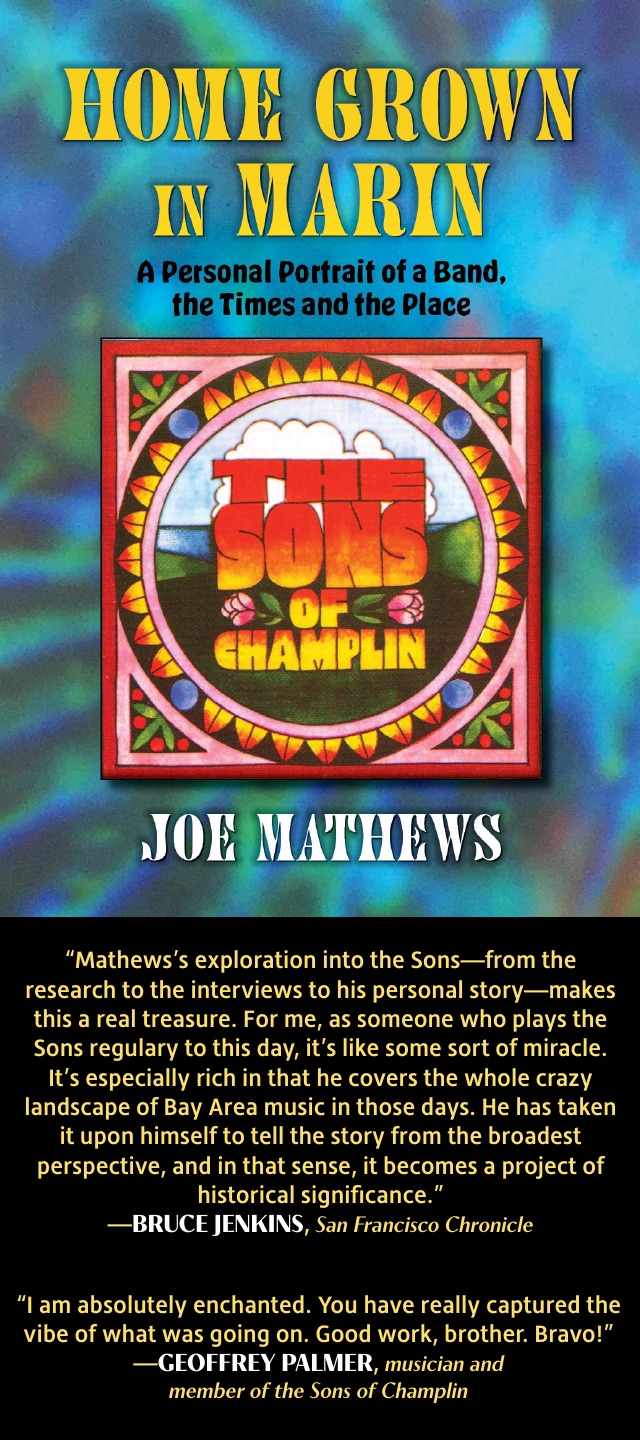
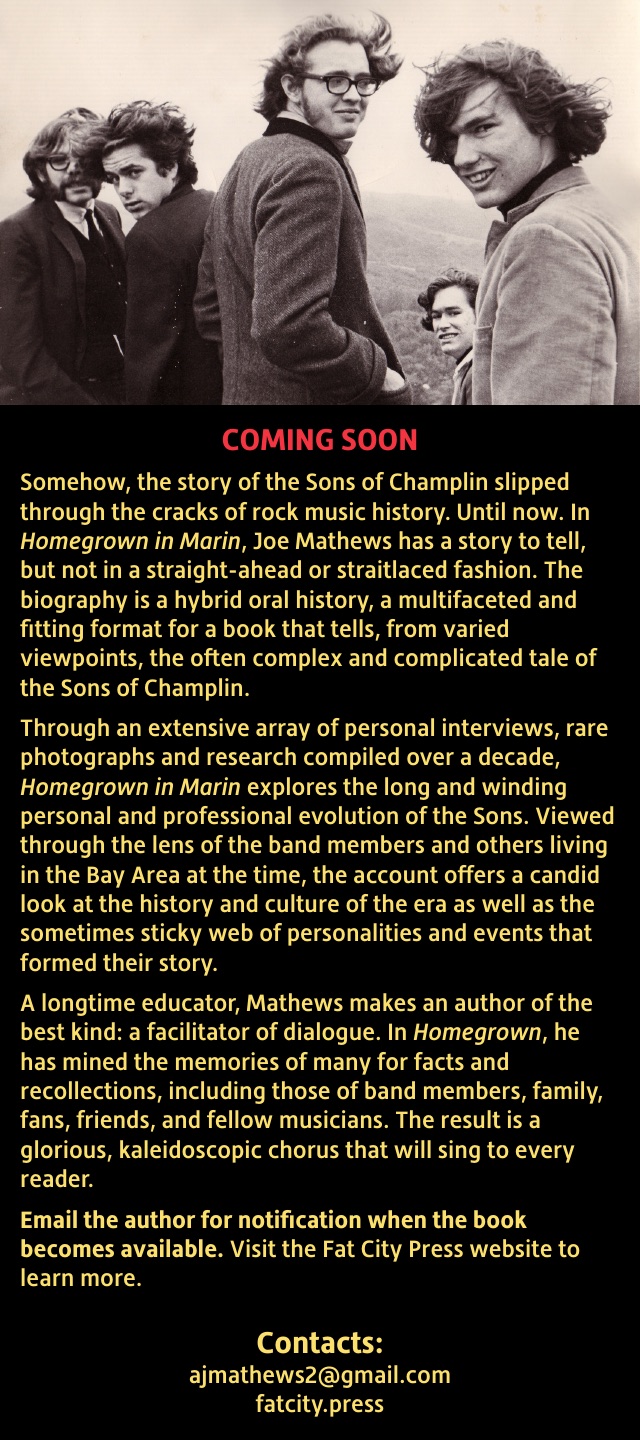
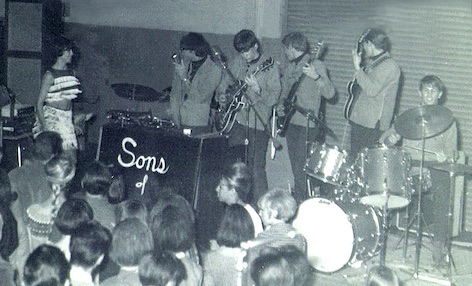
The Sons of Champlin A Personal Portrait of a Band, the Times and the Place
“These gentlemen have been around as long as we have, and thank God for that. From Marin, the Sons of Champlin.”
FrontBack
A unique feature of Home Grown in Marin is that the story of the Sons is embedded within the cultural and historical conditions of the time and place where it all unfolded. The Bay Area was unlike any region in the country then, and the music scene was especially vibrant and unique. Because the Sons and their music were that and much more, they were a perfect lens through which to view it. The book excerpts provided here will give you an idea of what you can expect once embarking upon the full journey.
Manuscript Draft — Opening excerpt from the Introduction to Home Grown in Marin
“These guys were the real deal, straight from California. We’d never met actual Marin County hippies before.”
When the Sons pulled up at the Boston Tea Party in December 1969 to play for two nights, they were already several weeks into a two-month tour that had them blazing across the Midwest and on to the East Coast before returning home for a date at Winterland on New Year’s Eve. One of their many shows along the way was this one, and they made an impression that stands to this day in the minds of those who welcomed them to Boston. Present that afternoon were friends and venue co-workers Stanley Kastner, his brother Andrew and Ed Simeone.
Stanley Kastner: Remember the Sons of Champlin? (chuckling) They were this group from the San Francisco area and this big vehicle shows up and all these guys pile out and they said, “Do you have a place where we can stay? We don't stay in hotels and motels.” Eddie and I looked at each other like, what? You want a room? So, we had this empty room at the Tea Party we called the mafia beat-up room. It was a windowless cave with padded walls and a steel door. We never knew what the origin of that room was but that’s what we called it. So we said, "Sure, you can stay here." I don't know how many people were in the band but it was a sizable number. Their manager rented one hotel room and they would go there to take showers. They were these Northern California guys and they had sleeping bags, and they had these sacks of granola and stuff they called road gruel, right? So they said, “Yeah, this’ll work.” Then they said to me, "Can you get us some pot?" At the time this wasn’t a big deal, so I said, "Okay, so how much do you guys want?" And they said something like a pound, maybe more, it was some ridiculous amount. So we went, "Okay." (2a)
Andrew Kastner: Back in Boston where we grew up, the weed we were used to was just sort of this Mexican shake, I had never even seen a bud before or anything like that. I thought pot was the stuff we were smoking. It wasn't that strong but you would get stoned, you know? So Bill Champlin comes to me and he says, "Listen, we're running out of pot and I've got to score a pound. Can you help me find one?" So I brought him over to see a friend of mine and Bill took one look at the stuff and said, “This isn't pot. I don't know what this shit is.” So he said, “I know a guy, why don't you come with me and I'll show you what real weed is.” So we drove across town and scored like a pound of, I think they called it sinsemilla. Afterwards we went back and they dumped the whole thing onto the floor in the middle of their circle. Then these guys rolled up, almost like cigars of this stuff. And before they went out on stage every one of them smoked one of these things. And I smoked one too. And I’ll tell you right now, I had never been this high before, or had seen a band this high before. Bar none. Remember now, I saw virtually every band that came through there, so that’s saying something. When the Dead came and played, Owsley traveled with them and his job was to make sure that everybody backstage in the club was tripping, right? Whereas with the Sons, they just gathered up and got stoned out of their minds. They weren’t concerned at all with who was or wasn’t getting high. Then they went out and played an amazing show. (2b)
Even by the lofty standards of the San Francisco music scene, by that point the Sons of Champlin had earned a well-deserved reputation for consuming prodigious amounts of always top quality weed. They were from Marin County, California, and this was the kind of lifestyle that many outside the region had only heard about but never encountered. Later, films such as Monterey Pop and Woodstock would forever cement the imagery of counterculture mythology in people’s minds. But when the Tea Party guys experienced the real thing for the first time, it was something else altogether.
Stanley Kastner: The Tea Party was right in Boston, on the same little street as Fenway Park where the Red Sox play. When you opened the front door onto the street, you'd be looking at the back of Fenway, and when there were games going you could hear the crowd cheering, it was right there. Baseballs would come flying over the wall right onto our street. It was a great spot. And it was just astounding who played our club. We were on the same circuit as the Fillmore, and the biggest acts would come and play multiple nights. All the great blues artists, everyone. The bill could be Eric Clapton, Fleetwood Mac, Joe Cocker, The Who, Little Richard, Muddy Waters, B.B. King, the Dead, Santana, and everybody else who was out there. I was hired for an insanely low amount of money, but I went from being a college student to working with every huge fucking rock and roll star in the world, you know? No one would have believed it. It was mind-boggling. So, my job as the stage manager was getting the bands inside and all their stuff unloaded and making sure everything was right. And that’s why I was there when the Sons showed up. And these guys were definitely an unusual outfit. Normal bands would come in, and they were obviously staying at some hotel. Their equipment managers would bring in their gear and they would do a rehearsal or sound check and then leave. But when the Sons rolled in, they came inside right away and asked, “Is there a room here we can stay in?” Like I said, it was hard to believe what I was hearing. So once we arranged it, they went back out and brought in all their stuff, their sleeping bags and their camping gear and shit, and they laid it all out in a big circle in the middle of the room. For us, it felt a little like a circus act coming through, the way they poured out of that van and got set up right there inside the club. Unconventional, that’s for sure. I remember one guy was on crutches, I think. They just did not look at all like the normal rock bands that came through the doors of that club. Definitely different from the Boston types or the British bands that were always there. These guys were the real deal, though, straight from Northern California. We’d never met actual Marin County hippies before, so it was something I’ll never forget. What a group of guys. (2c)
By the time the Sons arrived on that chilly December afternoon, enacting the unconventional was nothing new for them, it was how they operated. The Kastners and their crew were witnessing the stuff of legend that defined for many what northern California’s counterculture lifestyle was actually like. Although the Summer of Love’s media sensation established San Francisco as the nerve center, it was toward Marin County where many of the bands and artists migrated. Along with Marin locals Quicksilver Messenger Service and the Sons, other notables including the Grateful Dead, Big Brother and the Holding Company, Carlos Santana, and Van Morrison were soon calling it home. Places to live were plentiful, rents were cheap, and access to some of the most beautiful coastline and physical landscape on earth was further enhanced by the temperate year-round climate.
And for the guys in Boston as they endured another freezing winter on the East Coast? The contrast wasn’t lost on them as they imagined life in California for the Sons and their musician cohorts on the other side of San Francisco’s Golden Gate.
Stanley Kastner: One thing I have to say is, they're fucking lucky to be from Marin, man. My God, you're already in heaven. Living in paradise and smoking herb? Not bad if you ask me. (2d)
3
The Bay Area Music Scene: On the Ground
Introduction Excerpt
Manuscript Draft — Excerpt from the Introduction to Home Grown in Marin
For young people growing up in the Bay Area, the regional music scene served as a constant source of generational affirmation and grassroots community, and this too is a part of the story. That it brought people together there is no doubt. Musicians and performers speaking to this have often said how they too attended many of the same shows simply because the talent was so amazingly good.
Michael Shrieve: I used to go to Fillmore West all the time, driving up in my father's car from Redwood City where I lived. I would go and see everyone who played. That was the Mecca, you know? I'd go and see Charles Lloyd, and I'd go see B.B. King. I saw Jeff Beck and Jimmy Page, I saw Cream there. Everybody played there. I remember the Paul Butterfield Blues Band, especially East-West. To me that record kind of defined the sound of the Fillmore. If I hear that song, that kind of modal jamming going on there, I can smell the incense, I can smell the pot, I can see the apples that Bill Graham put out for the people, and I can see the pretty hippie chicks dancing and moving. It all comes back. A lot of emotion as well. (27)
Boz Scaggs: At the same time, I was with the Steve Miller Blues Band for eight or nine months and I got to see a lot in San Francisco too. A lot of the Chicago acts came out, the Texas bands. That whole Bay Area scene was a great melting pot of all kinds of music, when you have Ravi Shankar, Jimmy Reed, Cream, and everybody who was on the scene at that time. It was probably the greatest cosmo of music from everywhere ever. There was Miles Davis and John Coltrane, the poets Ferlinghetti and Ginsberg. Everybody came through San Francisco during that brief little period of time. I don’t think there’s ever been a confluence like that in the history of music. (Boz Scaggs speaks with Holger Peterson — see YouTube)
Mat Callahan: The variety of music throughout the Bay Area seemed boundless. On any given night, concerts featuring the Young Rascals, Count Basie, Bola Sete with Country Joe and the Fish, or Lenny Bruce and the Mothers of Invention were attended by large and growing numbers. No doubt rock music predominated the scene, but what constituted rock music was more diverse than is usually acknowledged. So many influences converged under the umbrella of rock that listening today to representative samples well known at the time defies categorization. Bill Graham especially was a trailblazer in this regard, assembling performers for shows that only a few years before would have been unthinkable. (28)
Bringing It All Back Home: Aretha Plays Fillmore West
“I saw you cryin’, and I saw you responding. But I was just about to bust wide open. You talk about bein’ moved. Not only because Aretha is my daughter. Aretha is just a stone singer!”
Without a doubt, one of the most capable record men to emerge from the era was Atlantic Records producer Jerry Wexler. Not only did he have a deep appreciation for the music of African Americans, he also possessed the instincts and skill to make things work on the commercial side. A perfect example was when he reached out to Bill Graham in early 1970 to cut a live album of Aretha Franklin performing at Fillmore West. Specifically hoping to connect with the young white audiences now frequenting the legendary Fillmore venue, Graham agreed to book her for a three-night run later that spring.
Despite her string of crossover hits, Aretha and Wexler had doubts about how she would be received and felt the gig was a gamble. But with a deep belief in Aretha’s unstoppable artistry, especially in live performance, and especially in this venue with a top-notch band backing her on stage, his instincts prevailed.
Jerry Wexler: John Hammond, the number one record man of all time in my opinion, had brought Aretha Franklin to CBS, but they just didn’t have the handles. They spent five years making a lot of beautiful records, records which I can enjoy to this day, but they didn’t find her niche. We picked her up, and because we now had experience working with people like LaVern Baker and Ruth Brown, and The Clovers and The Drifters and Joe Turner, we had the capability of finding her essence and finding how to showcase her. Which was to put her into a very basic rhythm and blues, gospel-tinged recording environment. And that’s what we did, and everybody knows what happened after that. (JM personal interview, 1995)
In combining Aretha’s selections of traditional R&B with her electrifying interpretations of songs already popular with white audiences, her performances were an enormous success and ranked as one of the top live recordings by any performer of the period. For Wexler, his nagging fear that the young hippie audience would fail to embrace Aretha evaporated on the band’s first downbeat.
Jerry Wexler: They were swinging from the rafters, swarming the stage, packed beyond capacity. It was thrilling to see the King Curtis band backing her. The rhythm section was cooking on high flame—Billy Preston on organ, Cornell Dupree on guitar, Bernard Purdie on drums, bassist Jerry Jemmott and Aretha herself on the funky Fender Rhodes.
“Y’all right? I’m movin’ in the right direction?”
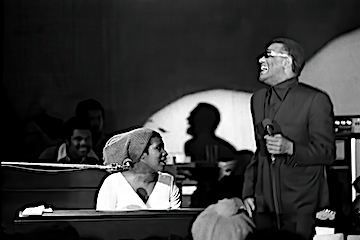
Aretha Franklin invites Ray Charles to close the show at her Fillmore West performance on March 5, 1971, part of a three-night run (March 5–7). (30)
Aretha would later call the Fillmore concerts a highlight of her career. Especially gratifying was the response of the young white kids in her audience. They picked up on the shading and nuance, were attentive, appreciative and hip to exactly what was happening. She poured everything into a setlist that included “Respect,” “Love the One You’re With,” “Bridge Over Troubled Water,” “Eleanor Rigby,” and “Dr. Feelgood.” And on the second night, she returned with the “Right Reverend” Ray Charles to close it out in a monster rendition of her “Spirit in the Dark.”
Aretha Franklin: I actually saw Ray a week or so earlier and told him what I was doing at the Fillmore, but I didn’t think too much about it—until that night and there he was in the crowd. The next thing I knew, he was up onstage and we were singing “Spirit.” It was really a fantastic show and one that I’ll always remember. (source)
Ray Charles: Well, as far as I’m concerned, she’s the right one, baby. I’m not much for hanging out, but I will go see Aretha. She’s my one and only sister. So I get to the Fillmore and I sit way in the back, trying to be inconspicuous and not bother no one, when all of a sudden someone spots me and the next thing I know, Aretha’s come to get me, talkin’ ‘bout, “I discovered Ray Charles!” (source)
The year before Wexler’s arrival at Atlantic in 1953, his partner Ahmet Ertegun had purchased Ray Charles’ contract from Jack Lauderdale, owner of the small Los Angeles independent label Swing Time Records. Within a year, Charles hit the jackpot with the sound he was searching for.
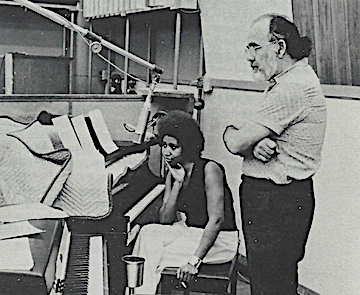
Aretha Franklin and Jerry Wexler in the studio. (Jerry Wexler personal collection)
Jerry Wexler: Ray was playing a nightclub called the Peacock and there was a hotel associated with it, and we met Ray at the hotel and he said, “Come with me, fellas.” We literally ran down the stairs, ran across the street, up the flight of stairs to this rehearsal. And there’s this band, and Ray sits at the piano and they start playing this incredible music. It’s Ray Charles. It was like it had sprung full-blown like that. Out of his vision. Out of his brain. And so the next day we went to record. We went to, it was actually a radio studio, a broadcasting studio on the campus of Georgia Tech. It was called WGST, and I guess it was 1954. And we cut four tunes there, including “I Got a Woman,” “Greenbacks,” “Come Back Baby.” But it was really a session from hell in that studio, because the engineer was an elderly gentleman who didn’t know the first thing about records. And we had to stop every hour to give the news. We stopped every hour. [chuckles] But we got out of there with some great records, and that was the beginning of Ray Charles. The real Ray Charles. (Joe Mathews personal interview 1995)
From these sessions came the music for the 1954 hit single “I Got A Woman” with “Come Back Baby” on the B-side, the record that launched Ray’s career.
“Would you play just a little bit for us? All right, beautiful…Ray Charles! The Reverend Righteous Ray!”
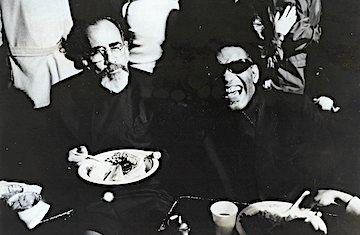
Jerry Wexler and Ray Charles enjoy a bite and catch up backstage at the Fillmore following Ray’s surprise appearance with Aretha. (Jerry Wexler personal collection)
Reflecting back on the Fillmore West concert, Wexler recalls his heart gushing with emotion as he listened to two of the most distinguished talents he’d ever had the great fortune to be associated with.
Jerry Wexler: On stage, they sang and played “Spirit in the Dark,” a meeting of two souls, two geniuses from two distinct periods of my life. Merging so easily, so naturally, so inevitably that all I could do was sit there and weep.
For Bill Graham, the 1971 Aretha Franklin show at Fillmore West was an exclamation point on a career that had seen his improbable rise as the bookkeeper for San Francisco’s Mime Troupe to the country’s most well-known and successful rock music impresario.
Bill Graham: I was introduced to the blues early on by people like Butterfield and Jerry Garcia, because I was mainly into Latin music. But as I got more and more into the rock and roll world, these musicians said, “You ought to check out the Staple Singers, you ought to check out Otis Rush. You ought to check out Buddy Guy, Junior Wells, Muddy Waters and Albert King, and B.B. King and Freddie King.” And in listening to them, their records, and then asking them to come here, all of a sudden this joyful situation presented itself where I could give the public what they asked for, which was the Jefferson Airplane or Quicksilver Messenger Service or the Grateful Dead, but also give them what they also might want, but not know it. (Bill Graham’s ’60s Celebration at the Fillmore, San Francisco, 1986)
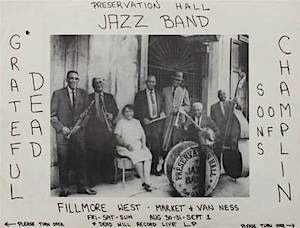
Bill Champlin: Lots of people bitched and moaned about Bill Graham on some level, but in a real way he put San Francisco on the map. Single-handedly. And some of the things he did, some of the bills of performers he brought in were flat-out awesome. I always thought that part of it was the best, the diversity of it. I mean, for three bucks I’d go to see The Rascals, the Airplane. I saw the Charles Lloyd Quartet with Keith Jarrett and Jack DeJohnette. Man, you know? The Sons and the Dead were actually on the same bill for three nights with the Preservation Hall Jazz Band at Fillmore West. Now how’s that for unusual? He would be bringing in guys who were not well known in the mainstream at the time. He did it a lot, and in that way, Graham was a true public servant. (29)
Bill Graham: I was fortunate enough to be there. That spirit, I am quite certain, is not going to exist again in my time. The guy on stage wasn’t just an entertainer, he was part of our gang, part of our scene. He walked the same streets I did. I might not know you, but you’re against racial inequality, and you’re for the things that I’m for. (Bill Graham’s ’60s Celebration at the Fillmore, San Francisco, 1986)
To this day I can easily recall the delight of walking in with friends to Fillmore West or Winterland and settling in for the evening’s performances. Without fail, the quality of the bands, particularly the headliners, was always first-rate. Adding to the anticipation was the welcoming ambiance inside: low lighting, music flowing discreetly from the PA, light show artists weaving film montages over scenes of abstract color and art. On stage, the glistening assortment of mic stands, amp stacks, drums and other sound equipment stood ready to deliver the goods. As always, the air was filled with the aroma of an open and unencumbered enjoyment of people lighting up the killer weed. And save for a few on security detail looking the other way, nary a menacing soul was anywhere to be seen. For the audience, there was a knowing comfort in the subtle sophistication and professionalism of the operation, that it was a safe space and the people running things knew what they were doing and liked being there. In speaking with others about their recollections, this was a common experience. And although these events did not speak for any specific ideology or collection of cultural beliefs, there was an undercurrent of like-mindedness and shared understanding among the crowd. It was an atmosphere where people knew they belonged, and being there always felt right.
Listening to the Voices: Project Methodology
The end result of all the interviews and research, is a kind of oral memoir; a biographical account that lies somewhere between a conventional history and a personal chronicle resting on the testimonials of people who were there and experienced it, including my own. Nearly fifty men and women signed on to participate, some doing multiple interviews. The result was more than 150 hours of recorded dialogue and hundreds of pages of notes and transcribed material.
Everywhere I went, news of the project preceded me. Everybody was interested in knowing how life was treating old friends and comrades, and all were curious to know how others remembered the days past. I was surprised at first with the willingness to share what were often very personal insights and perspectives, but trusting to have their voices heard meant gaining some control of the story on their own terms. Some of what was shared was off the record, and some of the knowledge lies between the lines of the text. Through it all, I was granted the privilege of entering into a world that was often different from what I knew, expected, or necessarily understood. Speaking to the advantage of firsthand personal testimony, veteran activist and journalist Gloria Steinem articulated what I came to learn.
“[It is not surprising] that oral history turns out to be more accurate than written history. The first is handed down from the many who were present. The second is written by the few who probably weren’t.” (31)
For the purposes of this book, relying more on the former guarded against overdependence on the latter.
Finally, Home Grown in Marin is a look at a celebrated period of American popular culture, where much of the music that came from it was distinctive and unique, something the work of the Sons of Champlin exemplified. To this point, renowned Atlantic Records producer Jerry Wexler recalled his experience of recording some of soul music and R&B’s best during this same period.
Jerry Wexler: We didn’t know we were at some cosmic threshold, you never know that. It’s like certain movements in art. It’s like that place outside of Paris where the light is so good, the Barbizon school, you know? The confluence of certain things, when the music was fresh, the musicians were fresh. You can’t replicate it because there’s something in the ambience, something in the atmosphere. (32)
As viewed through the lens of the band members and others living in and outside the Bay Area during this time, this story offers a candid look at the quest by a collection of young Marin County musicians to pursue their craft in a particularly challenging and consequential time in history. From their artistic genesis as young teens playing in public high school music programs, through the long and winding evolution of their professional career as the Sons of Champlin, these pages present the compelling maze of personalities and events that formed their story.
4
Chapter 7
Hello Sunlight: Awareness and Awakening
Manuscript Draft — Chapter 7 from Home Grown in Marin
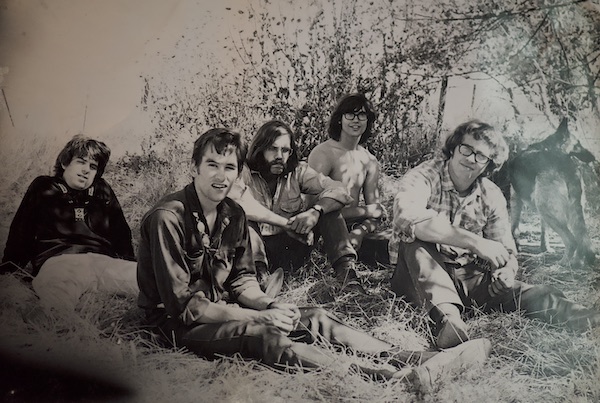
Left to Right: Al Strong, Bill Bowen, Terry Haggerty, Bill Champlin, Tim Cain, (Photograph by Fred Roth, 1966).
“Everything was a joke to us. At the time we were just booze swizzling, cigarette smoking, hot-rod driving musician idiots. We hadn’t smoked any weed. We hadn’t done anything. We’d just been getting drunk and going, yeah, let’s see what happens if you push this gas pedal down real hard.”
“We played a ‘battle of the bands’ at our high school. There were only two bands in the competition, ours and another composed of close friends. We set up on the auditorium floor. On the stage above us was the Sons of Champlin. We were sixteen-year-olds. They were twenty-year-olds. Men.”
How a few short years can make a difference at this stage in life. Most anyone with older siblings can readily attest to the dynamics of age difference.
Mat Callahan was in the eleventh grade at Lick-Wilmerding High School in San Francisco when the Sons performed there in spring 1967. This was the same KFRC-Pepsi Battle of the Bands competition that saw them play at several Bay Area schools that year, including down the Peninsula that April at Woodside High School in Redwood City. The Human Be-In had taken place just four months earlier. Two weeks before that was the Trips Festival. The Beatles released Sgt. Pepper’s Lonely Hearts Club Band on June 1 and Monterey Pop followed two weeks later. Julie Salles was a huge music fan and wanted desperately to go. But getting there required the help of an older sibling, so recruiting her was the key.
Julie (Salles) Haas: I was the one who got the Monterey Pop thing off the ground. I said, “This is going to happen no matter what,” and I got it orchestrated. My older sister got pulled into all of this too because she had to drive. She had the driver's license.
By 1967, the Bay Area music renaissance and Haight-Ashbury counterculture scene had shifted into high gear. Monterey Pop brought nationwide attention to the new music and immediate star recognition to a multitude of barely known bands, including several from San Francisco. These were the “first generation,” including the Jefferson Airplane, Country Joe and the Fish, Grateful Dead, Moby Grape, and Big Brother and the Holding Company, whose show-stopping rendition of “Ball and Chain” brought the house down on Sunday evening. Who can forget the festival documentary capturing Mama Cass seated in the front row for Janis Joplin’s monster performance and mouthing, “Wow”? As it was, she could have just as well been speaking for the entire artistic sea change that was unfolding, with San Francisco at ground zero.
The “first generation" designation separated these bands from those that followed because they were simply the first; the pioneers, the trailblazers. As the Haight-Ashbury counterculture evolved and increasingly drew the focus of the public eye, these bands were the out-front representatives of the movement’s ethos and idealism, attracting not only other artists but also the young fans who came to hear them play. Many of the musicians lived in the neighborhood and were central to energizing the unfolding scene. On top of this, they were, in most cases, just that much older and possessed the requisite depth of experience, panache, and local street credibility to warrant a slightly different level of recognition and respect from those who followed.
Bill Champlin: You know I really used to enjoy Chet Helms. Chester was always very nice to us from the start. He was a very sweet guy and there was just something about him that was very cool. I can remember talking on the phone with him several times the last couple of years he was alive. But the fact is, I was always a little shy when we played those early gigs, and kind of kept in the background. I probably would have felt more comfortable had I been more involved in the San Francisco scene. But I would just look at all these other guys in those bands like, these guys are the royalty, I can't talk to them. I know it sounds strange but it was true. Really. [chuckles] Yeah, Jack Casady, Jerry, and all the others. We’d share the same stage but the interaction was never really there, I was always a little intimidated. We were younger, for sure, and not of the original Haight-Ashbury scene, and they were in the middle of it, made it what it was in a way. They really were San Francisco music royalty, you know? The Airplane and the Dead, Big Brother, and Quicksilver. The only guy out of that whole scene I knew really, was John Cipollina. He was from Marin and John and I always got along well. And David Freiberg was always just a sweetie pie and still is. One nice guy. But for me in the early going, it was always a little hard to talk to all those guys.
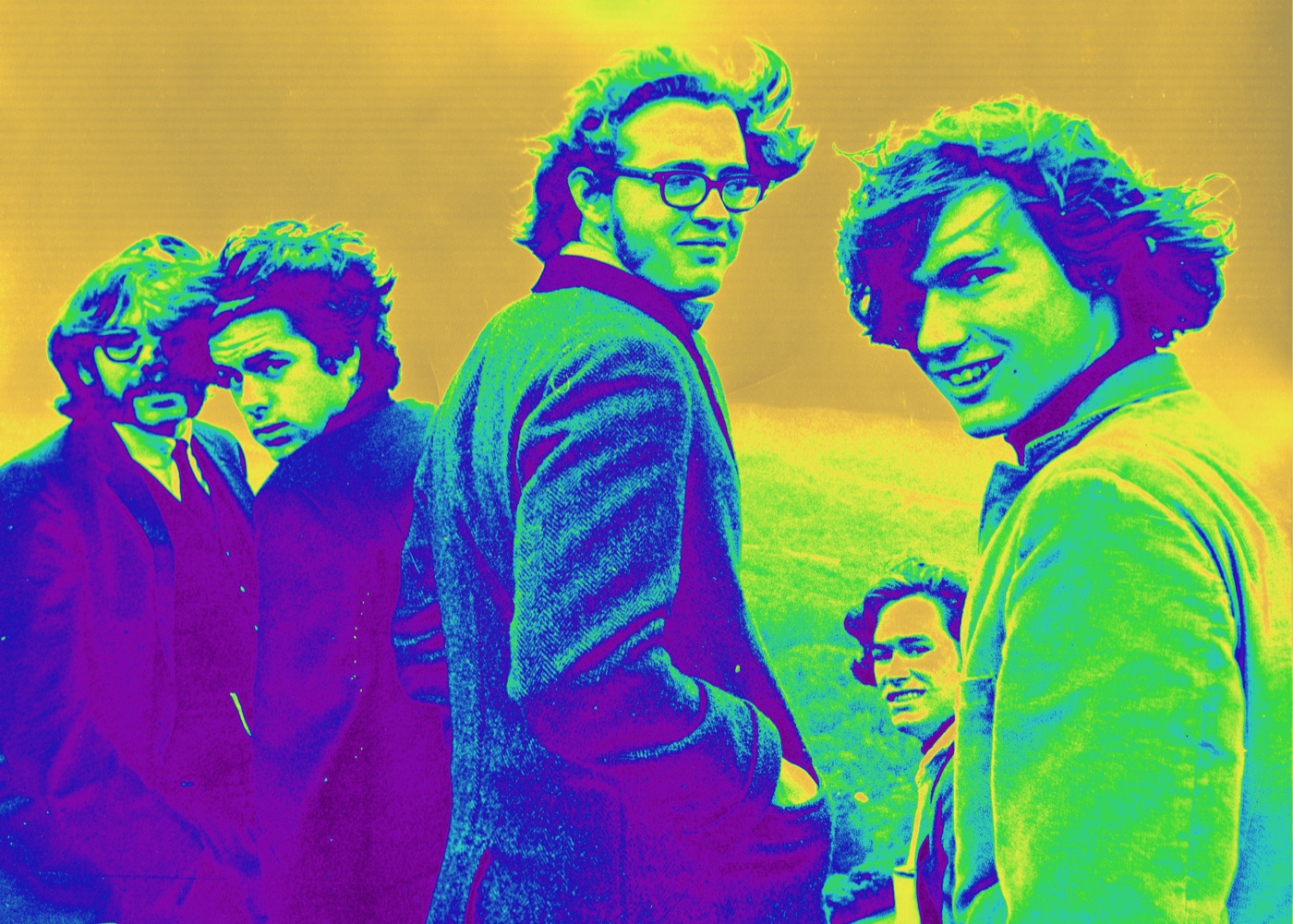
Above: Sons of Champlin, circa late 1965 and prior to signing with Trident. Left to right: Tim Cain, Bill Champlin, John Prosser, Terry Haggerty, and Jim Myers.
In a way, Champlin’s reticence makes perfect sense. Along with fellow “second generation” musician Carlos Santana, Bill was born in 1947. Phil Lesh, on the other hand, was born in 1940; Jerry Garcia in 1942; Joe McDonald, the same. Both of them had been in the service by 1960, the same year Champlin was in the eighth grade and graduating from middle school. Santana drummer Michael Shrieve by comparison, was two years younger still and in sixth grade. As it stood, when Bill Champlin, Tim Cain, and Terry Haggerty formed the Sons of Champlin in the fall of 1965, they were barely removed from Marin County public high schools. By then, Marty Balin had opened The Matrix on Fillmore Street, while Garcia and company were living the rough-and-tumble life of playing bar gigs seven nights a week, soon to hook on with Ken Kesey and the Merry Pranksters as the house band for the nascent Acid Test happenings. At this stage, the Sons were relative youngsters by comparison, not only in birth years, but in life experience.
Tim Cain: You know, at that point we hadn’t heard of anything deep or profound. We were just guys who had been getting drunk on the weekends from the time we were fifteen until we started smoking weed later on. Mostly we went out drinking, smoked a lot of cigarettes, and tried to pick up on chicks. And I was also really into my car. I built my car, was constantly under my car. I raced my car, I waxed my car, I cruised and tried to pick up chicks in my car, and was rejected repeatedly in my car. You know, I was just pretty much a nerdy kid with a cool car.
Although there was band experience by then, particularly for Champlin and Cain as members of Marin’s high-octane sextet the Opposite Six, their performances involved doing mostly covers in venues geared for local teens and high schoolers, with little chance of advancing the music. By age 17, Bill Champlin was married with a young son and was certainly qualified to claim some serious life responsibility there. But the fact remained that these guys were like so many other young men their age who were searching for inspiration, direction, and a path forward into the future that did not include soldiering in the jungles of Vietnam.
As it was though, by 1967 the Sons had a recording contract, a single on the radio, and were out there having a good time making a living playing music. Not too bad.
Enter Fred Roth
He (Fred Roth) did more than anyone can imagine to mold the Sons into a world-class band, introducing us to all kinds of new ideas about life and love, kindness, and responsibility.
Fred Roth was born in Marin County, coming into this world at Ross General Hospital in 1937. His California lineage dated back to the mid-1840s with his parents making their way to Nicasio and the San Geronimo Valley via their Castro Valley roots in Alameda County. Like many others, including Charlie Kelly’s parents, when the United States entered World War II in 1941, Fred’s folks hired on at Marinship in Sausalito.
Fred Roth: My family were dairy farmers, Irish, Spanish on my mother’s side. So my mother, during the Second World War, married this German fellow, and they were as opposite as two people could possibly be. They were working at Marinship when they met, a big shipyard in Marin County. Marin City was a part of that. My father was a short, mean-spirited, angry man who consumed a case of beer a day. Extremely bright guy, though, super bright, right over the top. Way, way too smart for himself.
As was his father, Fred Roth was highly intelligent. He was also artistically gifted and developed his talents from childhood throughout high school where he excelled academically in all areas. As a handsome and charismatic young man, Roth made friends easily and was a natural in social settings.
Fred Roth: I ended up going to San Rafael High. I graduated in 1956 and was president of my class all four years; it had never happened before. I was a real politician, right from my freshman year. I actually got invited to the senior ball by a senior girl when I was a freshman, and, man, did that piss off a lot of guys.
Roth grew up in postwar California in the 1950s, a landscape as wide open and full of opportunity as existed anywhere in the world. As a person possessing real talent, social instincts, and a willingness to put himself out there, practically anything was possible.
Fred Roth: Moving through the fifties and into the mid-1960s, it was really a special time to be in California and it was especially unusual in the Bay Area. Being young and living in this place after the Second World War, there was so much freedom and so much space in our lives. If you wanted, you could just roll along with everything that was happening in front of you. That’s kind of how it felt to me. California was exploding, there was so much money out there and so much going on. If you wanted it, opportunity for adventure was everywhere and there for the taking. So that’s how it always seemed to happen with me, just having been a native to this place, being present, and watching it unfold.
Once graduating from high school, Roth pursued his passion for the arts with a focused eye on earning a degree from the renowned San Francisco Art Institute. Enrolling first at the College of Marin, he eventually transferred and graduated from SFAI with a bachelor’s in fine arts in 1964.
Fred Roth: It was really amazing, because the Art Institute in those days was in its most glorious time. I had some talent, sure, but I got to hang out with, and was actually neighbors with, some of the most famous artists at the Art Institute from that period. [William T.] Wiley, and [Robert] Hudson, Bill Geis, Jack Fulton. We were all hanging out together, and again, I just happened to land in the midst of it with all those talented people.
With degree in hand, Roth returned to College of Marin where he had been a student assistant to the head of the art department. After excelling at SFAI and with numerous awards and accolades to his credit, he took advantage of this inside connection and was soon offered a job teaching ceramics. Secure in his new position as a member of the school’s faculty, Roth seemed well on his way to a charmed career as a college art instructor.
College of Marin at the time had one of the top ceramics programs anywhere in the state. It was also centered in an affluent area when California public education was flush with property tax funding. It was an exciting time and one that afforded enormous opportunity, especially to students of modest means like Fred Roth. At the time, public education in California featured quality K-12 schools nearly everywhere, a growing web of local junior colleges, a large state college network and the University of California system where UC Berkeley to this day is still considered by many as the top public university in the world. Responding to the unprecedented demand prompted by the baby boom, California and the San Francisco Bay Area moved into the 1960s as a place where it was theoretically possible for anyone to acquire a public education from kindergarten through PhD, fully funded on the taxpayer’s dime.
Now ensconced in the world of teaching art, Roth soon found that a certain amount of politicking was required to keep the department running smoothly and the funds rolling in. As a capable and eager neophyte, he jumped in and enthusiastically applied himself to meet that challenge.
Fred Roth: Back before Proposition 13, property taxes were super high in Marin County so the College of Marin was unbelievably rich. And we also had an art department that was supported by these rich old ladies, benefactors who had literally helped build it. So, they liked me and I was becoming popular in these circles because I was becoming really good at playing the game of getting ahead. In other words, I could still be the avant-garde artist guy, but at the same time I could also be the respected institutional insider by, you know, judging art shows and participating, playing the part.
As is the case for many in institutional settings, Roth learned how to navigate the demands of keeping the system afloat while staying true to his own values and professional standards. He was an artist first, so compromising aesthetic quality to meet outside agendas proved a difficult quandary.
Fred Roth: So I was coming along. I was getting all my chops together, winning prizes and going to shows, and toeing the professional line. But there was a lack of authenticity to it all, you know? And it was troubling. Sometimes I’d be invited to judge at shows, and I’d say, “I just don’t think this piece is very good.” But then I’d be told that this was their time to win the prize. And I’d say, “What are you talking about? It’s not a very good piece; they can’t win.” And they’d say, “Hey, you’ve got to understand how this club works.” So I was constantly coming across that kind of bullshit. You could become very expert at playing the system and very skilled about doing it, which I was. But I was feeling increasingly uneasy about it.
Calm in the Midst of the Storm: Albert Saijo
“He was the little Japanese Zen master hepcat sitting cross-legged in the back of Dave's [Lew Welch’s] Jeepster.”
“It all started with Albert.”
Albert Saijo, author, philosopher, woodworker, and poet, was the second-born son in a Japanese family of immigrant farmers living in California’s San Gabriel Valley. When the attack on Pearl Harbor happened in December 1941, the Saijos, including Albert’s older brother Gompers (named for American Federation of Labor founder Samuel Gompers), were among the thousands of American citizens of Japanese ancestry subsequently forced from their homes by FDR’s Executive Order 9066. Following an initial processing at the Pomona Fairgrounds, they were transferred for internment at Heart Mountain concentration camp in Wyoming. Albert’s interest in writing eventually led him to the editor’s chair of Echo, the Heart Mountain school newspaper where his literary persona began to emerge as a capable editorialist. It was here that he also began a long and fruitful friendship with the noted Zen Buddhist monk, philosopher, and teacher, Nyogen Senzaki, himself an internee. In 1943, as part of the War Relocation Authority program, Saijo left Heart Mountain for Michigan with plans to attend college but was soon drafted and served with the all-Japanese 442nd Regimental Combat Team as an infantryman in Italy before returning to Los Angeles after the war. Once reuniting with his family there, he learned that Senzaki was also in the area and began attending the twice-weekly sessions being offered in his tiny apartment in the nearby Little Tokyo district. By the early 1950s, Albert was writing regularly and attending the University of Southern California on the G.I. Bill with a focus on a degree in international relations. Unable to ignore the constant buzz emanating from the blossoming literary movement in San Francisco, he instead chose to follow his curiosity and left Los Angeles for the Bay Area in 1956. Once arriving in San Francisco, Saijo took a job at the Chinatown YMCA. It was here that he met many of the Beat artists on the scene, including Jack Kerouac and Lew Welch, who were attending alternative philosophy workshops there.
Artwork by Gompers Saijo.
Albert Saijo: Mostly these were kind of Zen-ish, which appealed to me, and that's why I went to the classes and is where I met my initial friends, mostly poets and writers and people in the arts and so forth. In the ‘50s, Zen was just beginning to become an interesting subject in America. In fact, not many people had even heard of Zen.
Also on the scene was the charismatic Englishman Alan Watts, who was teaching Zen Buddhism at San Francisco's newly formed Academy of Asian Studies while amassing a sizable following through a regular program on Berkeley's public radio station KPFA. With their shared interests, Albert quickly bonded with these Beat writers who were deeply influenced by East Asian art and poetry, sharing with them what he had learned from his teacher Nyogen Senzaki, and also his experiences in the American wartime internment camps. When Kerouac and Welch embarked on a cross-country trip to visit Allen Ginsberg at his digs in New York City’s Lower East Side, they invited Saijo to go with them. Along the way they composed an assortment of humorous haiku pieces that were later collected into a volume titled Trip Trap: Haiku On The Road, a word play on Kerouac’s On the Road and Riprap, Gary Snyder’s first publication of poems released that same year. Albert was later recast by Kerouac as the character George Bass in his 1962 novel Big Sur.
Once returning to the West Coast, Albert was married. Deciding to abandon city life, the Saijos retreated across the Bay to Marin County where he helped to maintain a "floating Zendo” started by Philip Whalen and Gary Snyder before Snyder departed on a scholarship to study Zen Buddhism in Kyoto, Japan. From there, they acquired a small cabin of their own in Mill Valley, tucked into a dense forest of bay laurels, oaks, and redwoods on Mt. Tamalpais. With the goal of further aligning his inner being with the natural world, Saijo began immersing himself into Marin’s expansive open space beauty with long hiking trips over the Inverness Ridge, later expanding these into ventures across the Sierra Nevada. Inspiration from these treks would lead to the publication of his book Backpacker in 1972, a guide designed for enthusiasts interested in minimalistic and noninvasive approaches to experiencing nature and the great outdoors. Continuing his passions for woodworking and the arts, Albert decided also to learn ceramics. After researching his options, he signed on for a course at nearby College of Marin. It was a section taught by Fred Roth, and with this chance meeting, perhaps the most important friendship in Roth’s life was about to unfold.
Fred Roth: After Albert had moved to Northern California and settled in Mill Valley, he and his wife Ann decided to take one of my intro ceramics classes at College of Marin. And I always began a new class by saying, “OK, I know everybody comes here with preconceived ideas of what they’re going to make, maybe a plate for your mother or something. But we’re going to do things a little differently today. The first project we’re going to do is build a birdhouse.” So Albert and Ann were making these really interesting birdhouses. Hers was this very classic oriental kind of palace birdhouse. And I remember Albert made a very modern-looking design that no bird probably would’ve wanted to go in, but it was a great-looking piece. And that’s how we met. I was maybe in my late 20s and Albert was probably in his 40s at that time, and we just started rapping. It wasn’t long before they invited me to dinner, and while I was there, he said, “You’ve got to check out these poets.” So we started going to poetry readings in San Francisco and I began to know some of the guys in that scene, including Gary Snyder after he had returned from Japan.
Turning On, Tuning In, and Taking Off
“Holy shit, I want to try that!
By 1965, media publicity had made LSD and psychedelics commonly known in the mainstream, especially after the Harvard scandals involving Timothy Leary and Richard Alpert went public. In spite of this, Fred Roth had no familiarity with it until the subject came up in conversation one day.
Fred Roth: One weekend when I was over at his house, Albert told me about this amazing experience he’d had. He’d gotten this substance through some friends of Tim Leary and he was telling me that after he took it he was sitting on his porch in the sunlight, and he could see the light going right through his hand. He could see all the muscles and blood vessels and everything else perfectly defined. And the light was going through there and into the wooden arm on the chair he was sitting in, and he could see all the cell structure of the wood. And then when he looked up, the whole sky had turned into this huge kind of cosmic pattern. And I said, “Holy shit, I want to try that!” Now, this was all brand-new to me. Absolutely brand-new, the first time I’d heard about it. So we made plans for me to try it the following weekend and Albert was going to be my guide.
Like so many others who experienced LSD for the first time, Fred’s experience was exceptional and would soon alter his direction in life. He was already in a professional crisis of sorts, and the psychedelic experience provided the impetus to seriously reconsider his choice to serve on the faculty at College of Marin.
Fred Roth: So, after I took LSD that weekend for the first time, I had an eight o’clock lecture class the next morning and I’m still not all the way down yet. Anyway, I was teaching an Oriental art history course I was assigned that really wasn’t a part of my background. I was constantly having to hustle to prepare for it because I simply wasn’t very well-versed in the material. And now I’m looking out at these students, and people are drooling and doodling and spacing out, you know, it’s 8 AM on a Monday morning. So I’m looking over this scene in the classroom and all the patterns are still going and everything, and I’m thinking, man this is not me at all. I’d had this amazing experience on LSD and I thought to myself, “Well, look, this just isn’t going to work.” So I walked across the campus to the president’s office and said, “I’m sorry, but I quit.” He jumped out of his chair and said, “You can’t do that.” And I said, “I just did.” You see, all these people had big expectations; they were grooming me, including the head of the department. So when I suddenly quit, it just created a mess and people were going on and on, “You can’t quit, what am I going to do?” And I said, “This is it, I’ve got to be what I’m supposed to be for real, not whatever the game has been made up for me to be, so I’ve got to get out of here.” And with that, I left and started doing photography because I was really interested in taking photographs.
Once leaving the classroom, Roth launched into photography with singular intensity. He had been dabbling in it for years and now had the opportunity to devote his full attention and energy to becoming a competent artist. Having barely taken a breath, he had soon established a reputation as a quality freelance photographer.
Fred Roth: And so I just went crazy over photography, I mean was just consumed by it, totally. And I ended up hiring on as a freelance photographic assistant for Sunset magazine, a great gig. I was traveling all over the western United States, doing a lot of gardens and architecture. I also did work for Architectural Forum, where we did a lot of very sophisticated stuff for set shoots; super tricky lighting, really elaborate. It would sometimes take literally two or three days to get the whole atmosphere and the lighting just right, running hundreds of Polaroids. There were lots of very cool assignments and I was really enjoying it.
During this time Roth fell into a serious romantic relationship with fellow artist Ann Hatch, who happened to be good friends with some of the people in the San Francisco Mime Troupe, for whom Bill Graham was the accountant. Following the highly successful Appeal III benefit at the Fillmore Auditorium in early 1966, Graham determined that his best opportunities lay outside the Mime Troupe and left for what he by then understood was his true calling. Knowing the emerging San Francisco music scene would require reliable venues and responsible management to operate them, Graham instinctively knew he was the guy to meet that challenge and so took the plunge.
Meanwhile, an exhausted Fred Roth finally took a breather from his full calendar of work and travel and settled in for a couple weeks of well-earned rest. It just so happened to be precisely when Graham was charging ahead with opening his operation at the Fillmore Auditorium and getting his staffing geared up.
Fred Roth: So, one of Annie’s friends at the Mime Troupe told her that Graham was going to start a dance hall, that he needed somebody to take tickets and would she be interested? She said yeah, that it would be fun. So then she asked about her boyfriend and could he come, too?” And her friend said, sure. So we went to work for Bill Graham right from the first gig. I was asked to do all kinds of things, from taking tickets, to stage set-up, to working up in the kitchen to cover the grill. Being at the Fillmore in those early days was one of the great experiences of my life because I got to listen to the best rock ’n roll in the world. But I was also still doing quite a lot of freelance photography. The first time I actually saw the Sons was at the Fillmore one night when Van (Morrison) was playing, and they were auditioning to open the show.
First Encounter
“Wow!”
In the summer of 1966, the Sons were hustling gigs as best they could with Tim Cain’s brother Bob filling the shoes as the band’s manager. In doing his due diligence, he took a chance and reached out to Bill Graham’s new Fillmore operation and learned there was an available slot for a Thursday night audition. The Sons were booked on the bill to open for the show’s headliner, Them. It was also a night Frank Werber and Randy Sterling were in the audience, the same who soon made a provisional offer to sign the band to Werber’s Trident Productions. In another extension of providential good fortune, Fred Roth, a huge fan of Van Morrison, was there as well. Not knowing anything about the Sons other than they were from Marin, Fred made it a point to check these guys out.
Fred Roth: I wanted to work that night for sure because Them was playing, and the Sons were auditioning as the opening band. Van Morrison was my favorite vocalist in the world. I know it sounds strange, but sometimes he would hit notes that actually brought tears to my eyes. I didn’t know what to expect, but when the Sons came on I was just knocked out by their set. These guys could really play. Some bands were so sophisticated, clean, and cool. Then here were the Sons who just played this kind of raunchy harder sound, and it came across as so musically cool. I thought, “Wow!”, and I made it a point later to tell them how good I thought they were.
Being in the mix at the venue, Roth was frequently in contact with the musicians who performed there and was often in conversation with them.
Tim Cain: We would sometimes go to the Fillmore to hear music and Fred would occasionally be up there cooking on the second floor. Blue Cheer might be playing, and driving everyone out of the hall, you know? (chuckling) So we might go up and have a hamburger and shoot the breeze with Fred. And if there weren’t too many people in there, you know, we’d just hang out and talk for a while. He liked our music and said so. We also learned that he was a talented photographer and were interested when he suggested that he shoot some publicity shots for us.
Bill Champlin: Fred and Annie (Hatch), who was his girlfriend, were working at the Fillmore, and Fred was sometimes in the kitchen upstairs cooking. But, he was a major photographer, and he was also very seriously connected with many of the local Beat poets and literary guys. Working the Fillmore was his way of kind of being around this burgeoning hippie counterculture movement, to be dead in the center of it, really. And his way of doing that, instead of buying tickets to the Fillmore every night, was working for Graham. So, when the bands would be playing, nobody’s buying burgers and he’s watching the bands, checking it out. He loved our music and our playing and saw something in us that was really cool. From the start we kind of hit it off.
Fred Roth: So I said, “Hey, let’s get together sometime and I’ll take some photographs, maybe get you some publicity.” I had a great little place up on Mt. Tamalpais with a terrific view, very close to where Albert lived. So they came by and I shot some photos and we just started hanging out. We all got along well, and of course I was smoking dope and they dug that, so pretty soon, you know, they were coming over more often. It didn’t happen all at once, but we developed a good friendship along the way and they were hanging out more and were eventually pretty much in and out all the time.
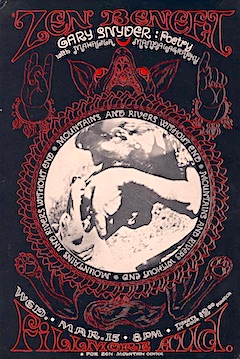
Left: By combining his black and white photography [center] and graphic art by Gompers Saijo, Roth composed his mandalagraph poster for the March 15, 1967 Fillmore benefit for the Zen Mountain Center. (Fred Roth Personal Collection)
In early spring 1967, the Sons had an opportunity to see Fred Roth operating at the Fillmore in a role that was far beyond his conventional activities there. On this night he was helping his friend Gary Snyder stage a benefit show to raise money to help the Tassajara Zen Mountain Center purchase property, now the oldest Japanese Buddhist Sōtō Zen Monastery in the United States. He worked on the slide show of photographs that accompanied Snyder’s reading from his epic poem Mountains and Rivers Without End, and also collaborated with Albert’s brother, Gompers Saijo, to design the poster for the event.
Fred Roth: This one was for a show I did with Gary at the Fillmore. It may have been the most successful benefit poetry reading that’s ever happened. I mean, who ever heard of a thousand people showing up for a poetry reading? It was amazing.
“Rainy Wednesday night. The Fillmore like it’s never been before. The stage bare except for a prayer rug, a microphone, lamp, wooden clappers and a candle. Smell of incense on the air. Gifts of food and flowers from Bill Graham for the Zen Center. A feel of comfort and warmth. Friends greeting friends. Sound of rain on the skylights. It was good to be inside.”
Al Strong remembers some of the band members traveling over to San Francisco for an extraordinary evening.
Al Strong: Fred and Gary Snyder were good friends and he told us that we should go hear this. He was working a slide show for the performance that night. They had all these photographs they had taken and Gary Snyder was reading with the slideshow going on behind him. Remember that I was a young beatnik before I ever played a note of rock and roll, so I was familiar with a lot of these guys. For me, jazz was my thing, but by that point with the Sons, I was really starting to get the rock and roll thing too. A lot of good music was coming up and it couldn't be denied. A lot of things were converging and this event just kind of clarified it.
New Manager, New Direction
By June 1967, the Sons and Frank Werber had mutually agreed to go their separate ways. At the same time, Fred Roth and the band members were developing an increasingly important friendship.
Fred Roth: By the time the subject came up later about me taking on managing the band, they had left Werber and any real network for booking gigs. It was pretty funny, really. We were talking about the advantages of getting out good PR with quality photos and such, and how they would be getting calls for gigs. And they said, “We don’t have telephones, we’re not around any telephones at all.” And then they said, “What about you, you’ve got a telephone. Do you want to manage the band?” And so I thought for a minute and said, “Geez. Well, OK.” I didn’t know the first thing in the world about any of that. But that’s how things came to be in the SF scene. We’re friends, we’d gotten high together. We were open, we’re mellow with each other, so let’s go on this trip with our friends. We’re not looking for super sophisticated lawyers and accountants, slick guys hovering all over us. We just want to go out and play music. So OK, let’s do it.
Roth was ten years their senior, and combined with his considerably deeper life experience, was becoming a valued and trusted mentor to the guys in the band. From his relationship with Albert Saijo, Fred had developed a meaningful understanding of the basic tenants of Zen Buddhism, which became the basis for living his life and of his advice and support for the band members. It is worth bearing in mind that these young musicians — Bill Champlin, Tim Cain, Terry Haggerty, Al Strong, and to a degree Bill Bowen too— were without functional father figures in their lives and hungered for this kind of nurturing presence. Having come from fractured family households where caring and thoughtful parental guidance was often absent or challenged at best, the compassionate and soothing voice of Buddhist reasoning made a welcome impression and was taken to heart. Many late-night conversations were devoted to exchanging ideas about living life as responsible and compassionate human beings on a planet that was hurting and in desperate need of nourishment from its inhabitants. Now with Fred Roth in their lives, here was a voice of calm, humility, wisdom, and experience who was making himself available to them as a confidant and advisor. Without exception, every one of the band members is adamant about the value and importance of having known Fred Roth.
Terry Haggerty: As far as me and my life are concerned, he was the number one person of importance. If I had a spiritual guru, it was Fred Roth, just the most amazing person. You just don’t make people like him. As far as being the Sons, he was one of the most influential people for us, we couldn't have done it without him. Talk about content richness. For a bunch of young guys who didn’t really know much about life, you could live a lot better with a lot more on what Fred gave us than making a bunch of money.
Tim Cain: He became our teacher, yeah. We all owe the development of our higher consciousness to Fred Roth. He introduced us to everything. He was ten years older than me, eleven years older than Bill. Terry’s the same age as I am. He was like a guru for us. He was a man who was compassionate, kind, understanding, forgiving. We’d heard about all these things, but what did they really mean? It was an eye for an eye out there in the world, pretty rough going, you know? We were just very young and primitive people, teenagers that had grown up in kind of a spiritual void, and nobody had told us anything. I didn’t have a father, so for him to be there as a kind of anchor was really important for me.
Bill Champlin: We were sort of in the pop world when we met, trying to hang on for dear life, and he really kind of explained to us, probably as much by his lifestyle as any of the ideas he shared, about art and what it is. He was an artist, and I learned a lot from Fred, in that art is really a craft. You do as much as you can for the craft, and the craft will sometimes eventually turn into art. He was an awesome photographer and really understood his craft. He once did a movie with us when we were a five-piece, where he assembled an entire film out of stills, up on Mt. Tam. It was beautiful. I don’t know what happened to it, but it was an awesome piece of work. The next time we played at the Fillmore, we showed it as part of the light show, coming up behind us onstage, it was very cool. So, I mean Fred kind of brought to us this sort of idea, you know, to believe in it. That if you do this on a regular basis, and that it becomes something that you just really fucking care about and go after, as a craft, you are going to discover some art. And that’s the kind of stuff that really resonated with me artistically. It was good and felt right. And he was basically kind of just setting us up for that first acid trip. And eventually we had that first acid trip.
LSD and “The Change”
I will never be The me they’d like to see And that’s cleaned, preened and inspected I feel an independence now And I don’t think that I know how To feel hurt, spurned and neglected
Taking LSD with Albert Saijo as his guide convinced Fred Roth early on about the importance of being in a safe and secure place with a responsible and experienced navigator riding alongside. It is the concept of “set and setting,” and was actually introduced and documented by Timothy Leary in the 1962 Harvard Psilocybin Project, probably Leary’s most significant contribution to the period’s psychedelic research. (MP, HTCYM, P. 151) The idea meant that the psychedelic experience was strongly influenced by the setting in which the trip was taken and the mindset going in, that the external and internal environments shape the experience. The subject of taking acid had already been discussed on numerous occasions, but before it could be formally arranged, some of the guys had an opportunity and took the plunge on their own.
Bill Champlin: So, Fred was just working us up to the point where we were going to do this. But then somewhere along the way, somebody got some of Owsley’s Purple Haze. We’re in Sausalito, and we take it. And pretty soon we go, “Whoa, this shit’s coming on strong. Let’s get up to Fred’s.” So we hop into my Econoline, we’re all in there, and I drive up to his place on Mt. Tam on the last bits of whatever straightness I got left. And we just walk into Fred’s house and told him that we were all so high we couldn’t fuckin’ believe it. And Fred says, “Cool. We’re here. You’re in the right place.” And at the end of the night after we all kind of finally came down, someone said, “Let’s go outside and watch the sun come up.” So we all went out for the sunrise, and Fred was talking about a lot of different things, that for us, nobody’d thought about. We’d had a lot of conversations by then, you know, like processed food, this is what they do to meat in this country. Commercialism and advertising, where the culture is going, the direction it’s taken, what’s really happening and how much is being kept from us. Politically. The War. Environmental awareness of our world around us. Lots and lots of stuff. And all this became part and parcel of the LSD experience, seeing it in a new light and becoming aware. So, for all of us, it was the beginning of a really interesting time. It was all so new. I spent a lot of time up to that point, and after that point, listening to a lot of these conversations about all this, and I was fascinated. And I sort of saw myself as a kind of chronicler of this entire psychedelic conversation. That was really what most of the first album was about, a different vision. I would hear certain things, and I would think, “Well, there is a way to phrase this and a way to phrase that.” You know, anytime I tried it as a party drug, I’m bummed. When it was right for me was when the conditions were right, and that's why I’m telling you about all of us heading up to Fred's once we knew we were in over our heads. Unless I got out into the hills, or someplace peaceful, it wasn't going to work. That very first hit I happened to be at Fred's house and I spent the whole night there. You know, your very first acid trip and we’re listening to Sgt. Pepper's Lonely Hearts Club Band? Pretty badass shit that was, right? It was after that that I began writing all this stuff that went with the music. The next day I wrote “Everywhere.”
The Sons in the Marin outdoors, fall 1967.
“Up there, there’s a place I know, it’s just a good place to go…”
Through their association with Fred Roth, the band members were experiencing enormous personal and spiritual growth, a phenomenon that began extending to their artistic output. Champlin in particular was becoming an inspired songwriter, beginning at this point to compose the material that would form their powerful debut album, Loosen Up Naturally. Combining a newfound knowledge and their experience with psychedelics, there was a revelatory newness and freshness to their worldview. It was an exciting and invigorating time in their lives that was ultimately reflected in the music that came from it.
Tim Cain: I was seeing things in an entirely new and different way. Taking acid outside during the day in the serenity and beauty of Marin was the best for me, it really accentuated the experience. Here we were in the middle of this incredible place, and I never really ever saw it before. Just looking across at San Francisco from on top of Mount Tam, there’s all this beauty around me, things growing and living and everything’s alive and vibrant. Then I’d look over towards San Francisco and it was like a huge concrete scar. You know, we’d have revelations like that, obviously it’s a scar upon the beauty of the earth, you know? There is nature all around you which covers everything with life, and all of a sudden it’s obliterated and covered by concrete. You know, it’s not very hard to see when you’re that stoned. This is the kind of thing Fred was asking us to notice, to see, you know? He was our conduit. We didn’t know what a bug was, we weren’t paying attention. Bugs were things you killed so you didn’t have holes in your food, right? So, a lot of what we learned was the idea that until we look for another way of seeing something, the way we’ve always seen it is all we’ll ever know. We began to see an incredible natural world out there that we need to take care of. We nurture it, it nurtures us. Mother Earth.
Such insights were central to the new sense of possibility and discovery that was emerging in their lives. Thematically speaking, “seek and ye shall find” became the guiding light.
Bill Champlin: With the LSD experience and hanging out with interesting people that knew something about what was happening, we were opened up to a lot of new ideas, new territory. Fred was the guide, and his circle was Alan Watts, and Albert Saijo, and all these different people. So the conversations that were coming down were of a much higher thinking than anything we were used to. As in, higher consciousness, get high, you know? It was very cool. They saw LSD as an important tool to get from one place to a different place, that it was not a party drug. That this is something you train for in a way. We weren't necessarily training for it, but were around where the conversation was pretty deep, so when we started getting high, what we had been hearing in our discussions, it gave us a chance to process it and to really get something going. Certainly not every time, but I had four or five trips that really did some shit to me. You know, it’s interesting. I was a really bad cigarette smoker and my vocal range was very low. I was still singing good but my range definitely had a relatively low ceiling on it. I had to stay inside it. It wasn't as bad as Joe Cocker or someone like that. But I can remember taking an LSD trip and was listening to the birds and thinking, man these motherfuckers have got some range. Somewhere in there the internal singer in me went, “Well, let's listen to this guy do a solo,” and then one of the birds would just go way up there, all over. This is what it was sounding like to me. And I realized that they don't seem to have any problem stretching it, why can't I get there, too? And I thought, “Well, you can, it’s called falsetto. Why haven’t I ever used it?” And I realized that when you do, they call it a girl's voice. Right? It was just a cookie crumb that somebody left at some point that just went, no, you can't do that because that's a girl’s voice and you're not a girl. Which was probably my reaction to it when I was seven or eight years old when I wanted to be Hercules or a fireman or a cowboy or some shit. That’s just a hang-up. All of a sudden I understood I was a singer and that's what I'm supposed to do and that this doesn't have anything to do with anything else but that. That day I got another octave and a half, maybe two octaves. All of a sudden I was no longer afraid, scared to use my falsetto. And I used it for years, especially when I was doing all those vocal dates later on. It gave me so much more to use. Had I not been high and taken that kind of a look inside, and heard those birds singing, I don’t think it would ever have crossed my mind. And definitely not with the certainty that it was not only possible, but that it was as natural as breathing air.
We all know it’s coming And you’ll know just what you have to do Can you hear the drumming? No time to witness the emergence of you And we’ll all be making love on a hillside in the rain If the inside is on the outside there’s no pain And wonderful is what you feel for you When you do the things you’re made to do
Brian Wilson’s same unease about his natural falsetto is well documented, having confided in those closest to him that “sounding like a girl” was perhaps his biggest artistic hang-up. For many who have tried it, one of the acknowledged outcomes of the psychedelic experience is discovering the vanishing of one’s ego, including the preoccupation with self-image. Aldous Huxley called ego the “reducing valve,” the faculty that eliminates as much of the world from our conscious awareness as it lets in. For Champlin, clearing that hurdle not only made possible the knowledge that he possessed this musical gift, but of the willingness to fully embrace it.
Michael Pollan: While the ego sleeps, the mind plays, proposing unexpected patterns of thought and new rays of relation. The gulf between self and world, that no-man’s-land that in ordinary hours the ego vigilantly patrols, closes down, allowing us to feel less separate and more connected, “part and particle” of some larger entity.
Had he witnessed a moment of lasting inner clarity and self discovery?
Bill Champlin: Absolutely! Oh, it's a little girl's voice, I don't want to do it. It was just something that simple. To be able to break that stuff down, I was able to transcend the bullshit that was holding me back. Then something that was not possible, became possible. LSD could do that, and did for a lot of people. In this case it was very therapeutic. Something that simple. But those little things will lay in there and that's one thing about acid, is that if you're paying any kind of attention, pretty cool things can happen…I always kind of looked at LSD as sort of like a toy spinning top. You know, the kind you wrap a string around and around and then unleash it? When you let it go, more and more of it is exposed until it's there for all to see, kind of like peeling back layers. You start to visualize in a way that otherwise doesn't happen. Churches and stained-glass windows with fantastic color and structure. It really can be a spiritual experience going far beyond anything that the normal conscious mind is capable of. Part of me would say okay, you are here in this place. Then I would be in a place that was anything but this place. And you go with it. Keep pulling the string and eventually there it is. So it's getting by all the things that would otherwise get in the way, that reveals a certain truth, I guess you can say. For me in this case, it had everything to do with that natural human sound that comes from within. It was more than just hearing it, it was feeling it, and knowing that it was there inside waiting to be uncovered. Listening to music, hearing it, is the same also. It wasn't about anyone's political stance or anything else, it was the sound of it. I mean being on acid and listening to James Brown say, “I'm going to go over to the corner and kiss myself”, well that conjured up some pretty weird stuff. You know, whoa! Here it is you're getting rid of your ego and you hear this? But man, what a groove! [laughter]. But really, it could be Black women singing, maybe a gospel choir. I'm an Aretha fan, and hearing this stuff when I was high opened up an entirely different audio world. It was magnificent, beyond description. Yeah, this is good. Keep going, keep going, keep pulling the string. Eventually you're all the way down and there you are. And that's the way LSD is supposed to work, and can work if it’s right.
For the Sons of Champlin, placing their trust inside the guidance and wisdom of Fred Roth felt right, and the optimism was palpable. Through their association with him, including the LSD experience, the band members had embarked on paths of self-discovery that awakened them to new senses of personal awareness and possibility. Having this to work with, an inspired Bill Champlin channeled the experience into a burst of songwriting and artistic creativity that redirected the band away from their more pop-oriented approach and toward the rich and brassy R&B feel that would define their sound for years to come. Of no less importance to this shift was the arrival that fall of multi-instrumentalist Geoffrey Palmer and the emerging arranging prowess of tenor saxophonist Tim Cain. Combining it all with a fierce determination to take their music to a higher level, the Sons worked tirelessly to lay out the new material for their upcoming debut release. Loosen Up Naturally would occupy a moment of genuine artistic relevance, for the timing of the record’s release and the messages contained within it, resonated perfectly with the challenges of the times.
Can you feel it comin’?
Bill Champlin: At that time, there was a real quest to make things different. That's a big reason why I started writing lyrics that were trying to be more substantive and personal. And also, we had been turned on to LSD, and if that isn't going to open things up, what is, you know? There was so much conversation and discussion about what was going on out there, politically, socially, with the environment. We were really trying to capture it and to put that into the music. We didn't want to separate our music from our lives.